
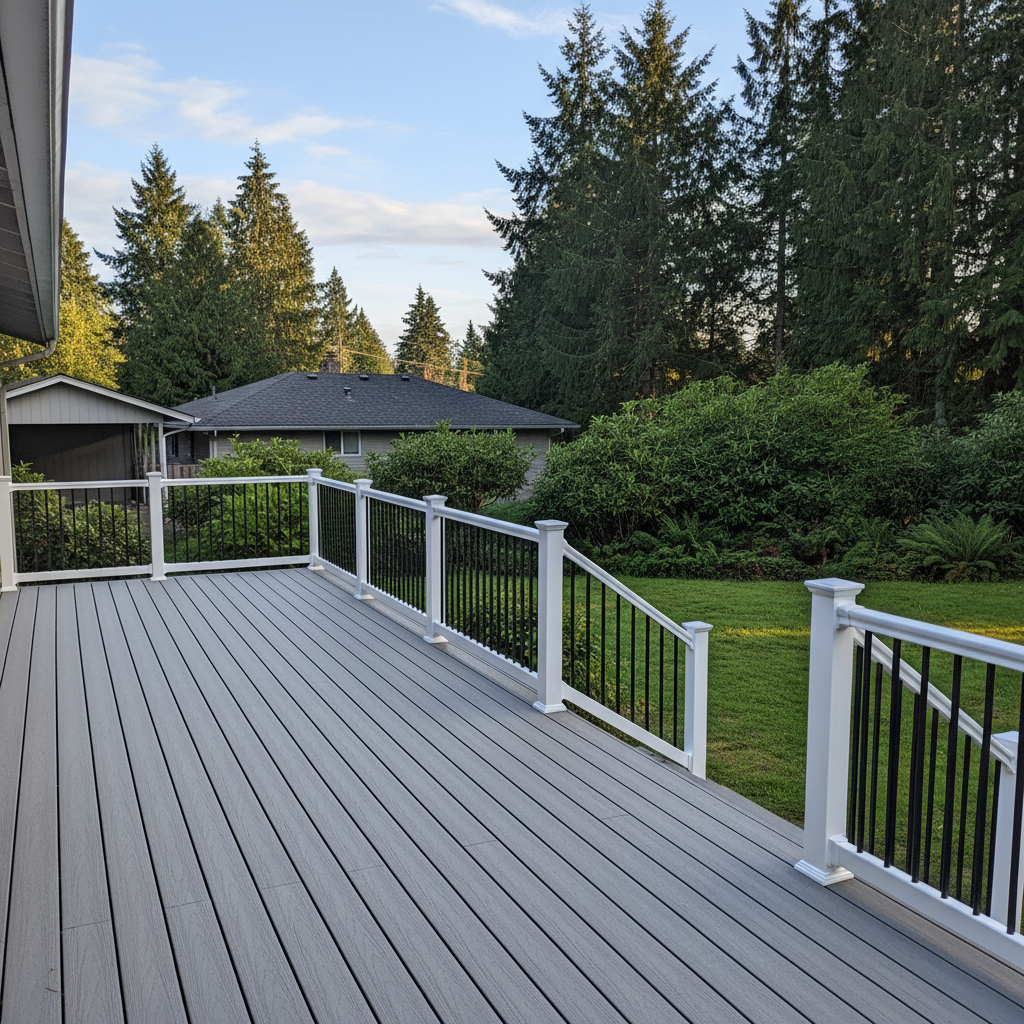
Most deck failures in this area don't start with the boards. They start with the ledger, the footings, or a permit that never got pulled. If you're hiring someone to build or rebuild a deck in Kirkland, those are the three things worth understanding before you ever look at a sample of composite decking or a railing catalog.
Start with the ground, not the design
Kirkland sits on glacial till in most neighborhoods, with pockets of fill and clay depending on how close you are to Lake Washington or a old creek bed. Till compacts hard and drains slow. Clay holds water and shifts a little as it wets and dries through the year. Either one will move a footing that wasn't poured deep enough or wasn't set on undisturbed soil.
A deck builder who knows this ground digs footings to bearing soil, not just to a code minimum number, and tells you when the dirt at 18 inches still looks loose and they need to go deeper. Frost depth itself isn't dramatic here, we don't get the frost heave you'd see in Spokane or back east, but soil bearing capacity is still the thing that decides whether your deck is flat in five years or has a corner sinking by the hot tub.
Permits aren't optional, and a good builder won't suggest skipping one
The City of Kirkland requires a building permit for most attached decks and anything more than about 30 inches above grade. That means a plan review, a footing inspection before you pour concrete, and a framing inspection before the decking boards go down. If your lot is close to a property line, expect a setback check too, and if you're in an HOA neighborhood, which covers a lot of Kirkland from Finn Hill to the newer streets off Juanita Drive, there's often a design approval step on top of the city's process.
A contractor who tells you permits are a waste of time or that they can "just build it and we'll deal with it later" is telling you they don't want an inspector looking at their footings. That should bother you more than the delay a permit adds.
The ledger board is where most decks actually fail
Kirkland gets around 40 inches of rain a year, most of it between October and April. An attached deck lives or dies on how the ledger board was flashed against the house. The board has to be bolted, not nailed, through the house rim joist with lag bolts or structural screws rated for the load. Behind it needs a layer of flashing, usually Z-flashing over housewrap, so water running down the siding sheds past the ledger instead of soaking into it.
Skip that flashing and you won't see the problem for two or three years. Then you pull back the decking near the house and find the rim joist soft and black. It's the single most common repair call in this trade in wet climates, and it's completely preventable with maybe twenty extra minutes of flashing work during the original build. Ask whoever bids your job how they flash a ledger. If they can't describe it in one sentence, keep looking.
Questions worth asking before you sign anything
Ask how they handle composite decking in summer heat. Boards like Trex or TimberTech expand and contract with temperature, and a deck built with boards tight against each other in June can buckle by August when the sun's been hitting it all day. A builder who knows the material leaves the gap the manufacturer specs, usually around 1/8 to 3/16 inch depending on the product, not whatever looks right that day.
Ask about railing height and baluster spacing. Code here requires 36 inches minimum for decks under 30 inches off grade, 42 inches above that, and no gap wider than 4 inches between balusters so a small kid can't get a head through. This isn't a design preference, it's inspected.
Ask for the name and rough address of a job they did in the last year or two, not a photo from a catalog. A deck that's been through one Kirkland winter will tell you more about the work than any portfolio shot taken the week it was finished.
- Do they pull the permit themselves, or expect you to?
- Do they pour footings to bearing soil or to a flat depth regardless of what's actually down there?
- Do they show you the ledger flashing detail, or just say "we flash it properly"?
- Is the bid broken down by material, labor, and square footage, or just one lump number?
- Do they carry liability insurance and are they willing to put a license number in writing?
What to walk away from
A bid that's dramatically lower than two others usually means something's being skipped, and it's almost never something you'd notice until the deck is five years old. Common corners cut: shallow footings, no ledger flashing, undersized joists spanning too far between beams, or treated lumber rated for ground contact being used where it shouldn't matter but does because of how wet our winters are.
Walk away from anyone who won't give you a written contract with a payment schedule tied to actual progress, not a big deposit up front with nothing to show for it. Walk away from anyone who talks you out of a permit. And walk away from anyone who can't tell you, without checking a chart, how far apart their joists will be for the decking you've picked, because that number changes depending on whether you're going with 5/4 cedar, composite, or standard 2-by lumber, and it matters.
A deck in this climate takes a beating from rain nine months of the year and sun reflecting off the lake the other three. The builder who gets the footings, the flashing, and the permit right the first time is the one whose work you won't be thinking about again for a couple of decades. If you want to talk through what that looks like for your lot, Fortis Outdoor Living is happy to walk it with you before anything gets dug.